
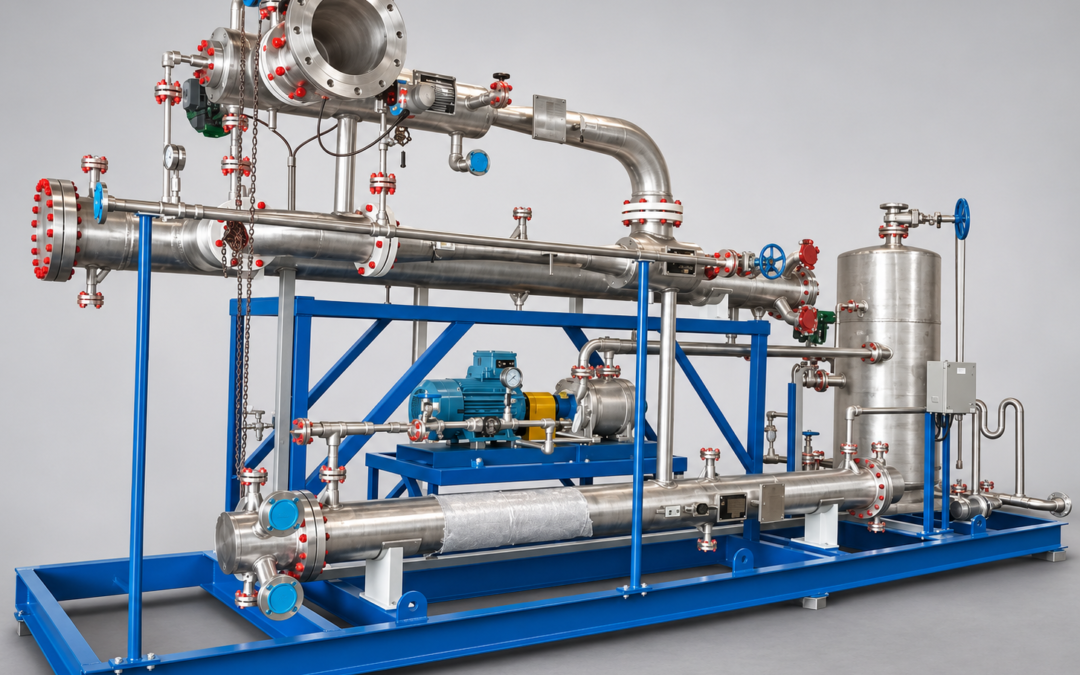
Modern industrial facilities depend on reliable equipment to maintain process efficiency, control operating costs, and ensure consistent production. Many manufacturing and processing operations require controlled vacuum conditions to remove unwanted gases, vapors, and other substances from process equipment. While conventional vacuum technologies can handle many applications, certain industrial processes benefit from a combination of different vacuum technologies. This is where a hybrid vacuum system becomes an effective solution.
By combining steam jet ejectors with mechanical vacuum pumps, hybrid systems offer an alternative to conventional multi-stage steam ejector arrangements. They are used in several industries, including power generation, chemical processing, oil refining, and pharmaceutical manufacturing.
What Is a Hybrid Vacuum System?
A hybrid vacuum system is an industrial vacuum arrangement that combines two technologies: steam jet ejectors and mechanical vacuum pumps, commonly liquid ring vacuum pumps.
Steam jet ejectors use high-pressure motive steam to create a vacuum and draw gases or vapors from process equipment. The gases are then compressed and discharged through the ejector. Mechanical vacuum pumps handle the final compression stage, helping achieve the required discharge pressure.
In a typical hybrid configuration, one or more ejector stages are connected to an interstage condenser and a liquid ring vacuum pump. The condenser removes a portion of the condensable vapor before the remaining gas reaches the mechanical pump.
This combination allows the system to achieve the required vacuum performance while potentially reducing steam consumption compared with an equivalent conventional multi-stage ejector arrangement. The actual savings depend on the process conditions, equipment design, and available utilities.
How Hybrid Vacuum Systems Work in Industrial Processes
The operation of a hybrid vacuum system involves several interconnected components working together.
First, the steam jet ejector draws gases and vapors from the process equipment using the energy of motive steam. The ejector compresses the incoming stream to an intermediate pressure before sending it toward the condenser.
Next, the interstage condenser cools the gas and condenses a portion of the vapor. This reduces the volume of vapor entering the mechanical vacuum pump.
Finally, the liquid ring vacuum pump handles the remaining gas and provides the final compression needed to discharge it at the required pressure.
The combination of these components allows industries to manage different gas loads and operating conditions. System configuration, ejector stages, condenser capacity, and pump selection are determined according to the specific application requirements.
Key Benefits of Using Hybrid Vacuum Systems
Industrial facilities often evaluate vacuum equipment based on operating costs, reliability, energy consumption, and maintenance requirements. Hybrid vacuum technology can offer several advantages when properly engineered.
Reduced Utility Consumption
One of the main reasons industries consider hybrid vacuum systems is the potential to reduce steam consumption. In a conventional multi-stage ejector system, additional ejector stages may be required to achieve the final discharge pressure. A hybrid arrangement uses a mechanical pump for the final compression stage.
This can reduce the amount of motive steam required, although electrical power and seal-water requirements for the liquid ring pump must also be considered when evaluating total utility consumption.
Reliable Industrial Operation
Steam jet ejectors have no moving parts, making them suitable for demanding industrial environments. Combining ejectors with a liquid ring vacuum pump provides a practical arrangement for handling process gases and vapors under specified operating conditions.
Proper equipment selection, instrumentation, and preventive maintenance are important for maintaining reliable operation.
Flexible System Configuration
Every industrial process has different requirements. Hybrid vacuum systems can be designed with different ejector stages, condenser arrangements, and mechanical pump capacities.
This flexibility allows engineers to develop equipment configurations according to suction pressure, gas composition, process load, and discharge requirements.
Efficient Handling of Vapors and Gases
Industrial processes often generate mixtures of condensable vapors and non-condensable gases. The interstage condenser helps remove condensable components before the remaining gas reaches the liquid ring pump.
This arrangement can reduce the mechanical pump’s vapor load and support effective gas handling.
Applications of Hybrid Vacuum Systems Across Industries
Hybrid vacuum technology is used in various industrial sectors where maintaining controlled vacuum conditions is essential.
Hybrid Vacuum System in Power Generation Plant
Power generation facilities use vacuum systems to maintain suitable operating conditions in turbine condensers. After steam passes through the turbine, it enters the condenser, where it is converted back into water.
Air and other non-condensable gases can accumulate in the condenser and affect its performance. A properly designed vacuum system removes these gases and helps maintain the required condenser pressure.
A hybrid vacuum system in power generation plant applications can combine steam ejectors and liquid ring vacuum pumps to provide the required gas extraction capacity. Equipment selection depends on condenser operating pressure, gas loading, steam availability, cooling-water conditions, and plant operating requirements.
These systems are relevant to conventional and geothermal power generation facilities.
Chemical and Petrochemical Processing
Chemical manufacturing involves processes such as evaporation, drying, distillation, and solvent recovery. Many of these operations require controlled vacuum conditions to support process performance.
Hybrid vacuum systems can help remove gases and vapors from process equipment while accommodating variations in operating conditions. The materials of construction and system configuration must be selected according to the chemical composition and characteristics of the process stream.
Oil and Gas Refining
Refineries use vacuum technology in applications such as vacuum distillation and other separation processes. Maintaining the required operating pressure is important for achieving the desired process conditions.
Hybrid ejector systems can be considered where engineers need to balance vacuum performance, steam availability, and electrical power consumption.
Pharmaceutical and Industrial Manufacturing
Pharmaceutical and manufacturing facilities use vacuum equipment in drying, evaporation, filtration, and other process operations. Depending on the application, a hybrid arrangement can provide an appropriate combination of ejector and mechanical pumping technologies.
The equipment must be designed to meet process-specific requirements, including vapor characteristics, cleanliness considerations, and material compatibility.
Factors to Consider When Selecting Vacuum Processing Equipment
Selecting suitable vacuum processing equipment requires more than comparing pump capacities or initial purchase prices. Engineers should evaluate the complete process and its operating requirements.
Some important considerations include:
- Required vacuum level: Determine the suction pressure needed to achieve the desired process conditions.
- Gas and vapor composition: Understand the properties of the gases, condensable vapors, and potential contaminants.
- Steam availability: Evaluate the pressure, temperature, and quantity of motive steam available at the facility.
- Cooling-water conditions: Consider cooling-water temperature, flow rate, and availability for interstage condensation.
- Electrical requirements: Account for the power consumption of mechanical vacuum pumps.
- Maintenance and reliability: Review equipment accessibility, maintenance schedules, spare parts, and operating conditions.
- Future operating requirements: Consider potential changes in production capacity and process loads.
A complete engineering assessment helps determine whether a hybrid arrangement is more suitable than a conventional ejector system or a mechanical vacuum pump installation.
Conclusion
Hybrid vacuum technology offers industrial facilities a practical way to combine the advantages of steam jet ejectors and mechanical vacuum pumps. By using ejectors for initial gas compression and mechanical pumps for final compression, these systems can provide reliable vacuum performance while offering opportunities to optimize steam and electrical energy consumption. Their suitability depends on careful engineering, process conditions, and the specific requirements of each application.
With more than a century of engineering experience, Croll Reynolds specializes in designing and manufacturing industrial vacuum solutions, including hybrid ejector vacuum systems, steam jet ejectors, and liquid ring vacuum pump systems. The company’s expertise in power generation, chemical processing, oil refining, and other process industries supports facilities seeking engineered vacuum equipment designed around their individual operating requirements.